
Whether you're sourcing power equipment for a new facility, managing a grid interconnection project, or figuring out why a substation keeps tripping, one question keeps coming up: do you need a step-up or step-down transformer? The difference matters, especially when you're comparing options across available transformer inventory. Get it wrong and you're looking at damaged equipment, failed inspections, or costly downtime.
This guide covers how these two transformer types work, what separates them in the field, and how to choose the right unit. If you're under pressure, you're in the right place.
A step-up transformer increases voltage from the primary winding to the secondary winding. A step-down transformer does the opposite, reducing voltage from primary to secondary. Both operate on the same electromagnetic principle explained in our guide to how an electrical transformer works: alternating current in one coil induces a voltage in another through mutual induction.
The difference lies in the turns ratio. More turns on the secondary side produce a higher output voltage (step-up). Fewer turns on the secondary side produce a lower output voltage (step-down). Power remains constant in both cases, minus real-world losses.
The classification comes down to how voltage changes between the primary and secondary sides. Two physically identical transformer cores can serve opposite functions depending on how they're connected and wound.
The turns ratio is the ratio of winding turns on the primary coil to turns on the secondary coil. If the primary has 100 turns and the secondary has 1,000, the transformer steps voltage up by a factor of 10. Reverse those numbers, and it steps voltage down by the same factor.
This ratio is fixed at the design stage. It determines insulation class, conductor sizing, bushing ratings, and core geometry. Field changes are not possible without a complete winding rebuild. When comparing a step up and step down transformer at the specification level, the turns-ratio of the transformer is always the starting point.
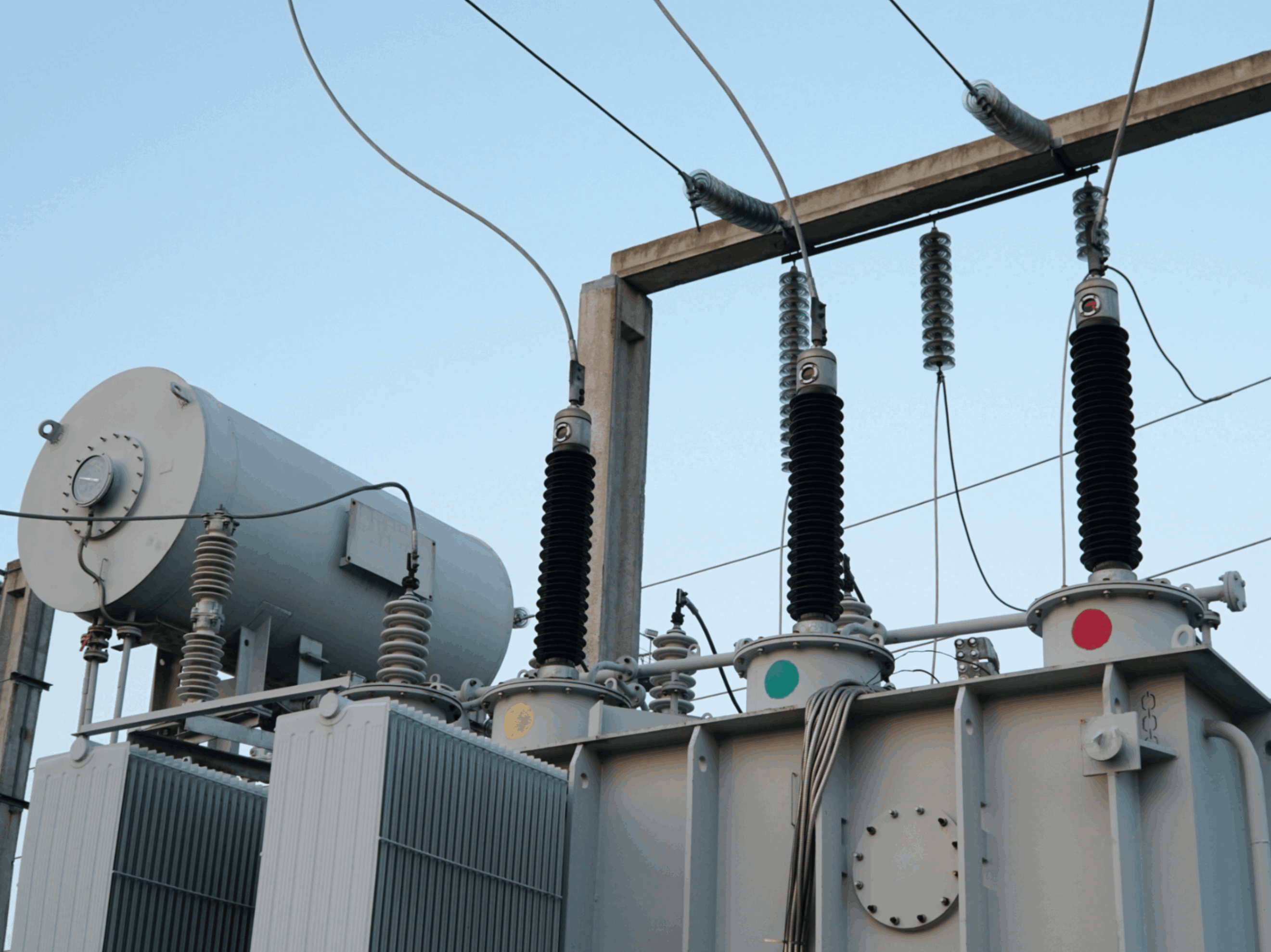
When voltage increases across a transformer, current decreases by the same proportion, and vice versa. This inverse relationship makes long-distance power transmission efficient. Raising voltage from 13.8 kV to 138 kV reduces current by a factor of 10.
Lower current means less resistive loss across transmission lines, which is why higher-voltage transmission reduces losses. That's why generation facilities step voltage up before sending power across the grid, and why distribution substations step it back down before it reaches a facility. The math is consistent: V1/V2 = N1/N2 = I2/I1.
The primary winding receives input power. The secondary winding delivers output power. In a step-up transformer, the primary winding handles lower voltage and higher current. The secondary handles higher voltage and lower current. A step-down transformer reverses this.
One practical note: some transformers are designed to operate bidirectionally, but most utility and distribution transformers are optimized for one direction. Using a unit in reverse without confirming the design specs can cause insulation failure, poor voltage regulation, or both. Always verify nameplate data and manufacturer documentation before reversing a connection, especially when decoding transformer nameplates.
Both transformer types share the same basic construction, but design details differ in ways that affect selection, installation, and long-term performance. Here's how they stack up directly.
These differences in voltage and current levels drive downstream decisions about conductor sizing, cooling method, and protective device ratings. Matching unit specs to your application from the start prevents costly retrofits once the unit is in service.
Delta and wye (also written as Y) describe how three-phase windings connect internally. A delta configuration connects windings in a closed loop. A wye configuration connects each winding to a central neutral point. Many step-up transformers at generation facilities use a delta-wye configuration: delta on the generator side, wye on the high-voltage transmission side.
This arrangement provides a grounded neutral on the transmission output, which supports fault protection systems. Step-down transformers in distribution commonly use wye-wye or delta-wye configurations depending on whether the secondary system requires a neutral conductor for single-phase loads.
Higher voltage means greater insulation demands. The high-voltage winding, whether it's the primary or secondary, requires more substantial insulation to prevent dielectric breakdown under operating and transient stress.
For step-up transformers in generation applications, the secondary winding carries high voltage and is the focus of the insulation design. Cooling becomes critical at higher voltage and current levels.
Oil-filled units rely on natural convection or forced oil-and-air cooling systems. Dry-type transformers use open ventilation or encapsulated windings. The right cooling method depends on load profile, ambient temperature, altitude, and whether the unit operates indoors or outdoors.
Some transformers are designed to operate bidirectionally, meaning the same unit can function in either direction depending on which side receives the input. This capability is more common in variable-frequency drive systems, certain renewable energy applications, and test environments.
For most utility and industrial applications, the short answer is no. Standard distribution and power transformers are optimized for one direction. Operating a unit in reverse can cause issues with insulation stress distribution, tap changer performance, and load regulation. Running outside nameplate specifications voids warranty coverage and may violate applicable codes and standards.
If a bidirectional unit is required, specify that at the time of purchase. Determining whether a reconditioned or new unit meets that requirement before committing to a configuration saves time and avoids costly procurement mistakes.
Step-up transformers appear wherever power needs to travel significant distances. Generation facilities, renewable projects, and distributed systems all depend on them to move electricity efficiently from source to grid.
Generators at power plants produce electricity at relatively low voltages, typically between 11 kV and 25 kV depending on unit size. Transmitting that power over long distances requires a step-up transformer for long-distance transmission, raising it to transmission-level voltages that move electricity more efficiently across the grid.
Generator step-up transformers (GSUs) handle this conversion. They are large, custom-specified units designed to match generator output ratings and grid interconnection requirements set by the utility or regional transmission organization. Lead times for new GSUs typically range from 12 to 24 months, which makes early procurement planning critical for any greenfield generation project.
Solar inverters typically output at low AC voltages, commonly 480V or 600V. Wind turbine generators operate in a similar range. Both require step-up transformers to reach collector-system voltages, usually 34.5 kV, and again to reach transmission voltage before grid interconnection, which is why they are so central to solar industry projects.
Collection system transformers for utility-scale solar and wind projects are procured in volume and must meet specific pad-mount or skid-mount configurations for field installation. Battery energy storage systems (BESS) follow the same general pattern.
Delays in transformer delivery directly delay commercial operation dates, which affects project financing and contracted energy delivery timelines. Sourcing in-stock or pre-positioned units can close that gap.
Distributed generation assets, including rooftop solar, combined heat-and-power (CHP) units, and fuel cells, often operate as distributed energy resources on the modern grid and may need step-up transformers to feed into local grids or on-site distribution systems.
Microgrids add another layer of complexity: the step-up function may operate in both grid-connected and islanded modes, requiring careful coordination with protection relays and automatic transfer systems.
Transformer specifications for microgrid applications must account for bidirectional power flow, automatic switching requirements, and compliance with IEEE 1547 interconnection standards. These are not standard off-the-shelf selections, and procurement lead times should be factored into project schedules from the beginning.
Once power reaches a facility or distribution zone, step-down transformers reduce voltage to usable levels. This is where most industrial, commercial, and institutional power systems converge.
Transmission-level voltage arrives at distribution substations, where large power transformers step it down to primary distribution voltages, typically ranging from 4 kV to 34.5 kV. From there, pole-mounted or pad-mounted distribution transformers step it down again to secondary voltages, generally 120V to 480V, following the delivery path from transmission to distribution used across the U.S. grid.
Each stage in this chain is a step-down transformer matched to the load characteristics of that zone. Utilities specify these units based on load density, fault current levels, and protection coordination requirements. Substation transformers often include load tap changers (LTCs) to maintain voltage regulation under varying load conditions.
Data centers and cryptocurrency mining facilities rank among the most power-dense applications a step-down transformer can serve. These operations commonly take utility power at 13.8 kV or 34.5 kV and step it down to 480V or 208V for distribution within the building, making them a strong fit for crypto industry applications.
Load profiles are continuous, high-density, and intolerant of power interruptions. Redundancy requirements often call for parallel transformer banks with automatic transfer capabilities. Crypto mining operations in particular tend to scale quickly, compressing procurement timelines.
In projects like these, in-stock units or tested reconditioned alternatives can make more sense than waiting on long factory lead times. When commissioning schedules leave little room for delay, fast availability can become just as important as exact spec matching.
Manufacturing plants, hospitals, universities, and high-rise buildings all rely on step-down distribution systems. The utility feed typically arrives at 12.47 kV, 13.8 kV, or 34.5 kV, and building transformers reduce it to 480V for motors and heavy equipment, then to 208V or 120V for lighting and general-purpose circuits.
Dry-type transformers are the standard choice for indoor installations in these settings. They require no oil and carry lower fire risk than liquid-filled units, making them appropriate for electrical rooms, mechanical floors, and occupied buildings.
Specifying the correct kVA rating, impedance value, and enclosure type from the start keeps the installation compliant and the equipment running.
Selecting the right transformer isn't only about voltage and kVA. Delivery timeline, budget, and how long the unit needs to operate all factor into the decision.
Start with the load. Add up the connected load in watts or volt-amps, apply a demand factor for actual operating conditions, and size the transformer with headroom for future growth. A standard guideline is to size at 70 to 80 percent of nameplate kVA under normal operating conditions. From there, confirm the primary voltage, the secondary voltage, and the number of phases, often using a transformer calculator.
Determine whether a specific impedance value is needed for coordination with upstream protective devices. With those numbers in hand, available inventory can be matched against the spec, or a custom order can begin.
New transformers carry full manufacturer warranties and meet current construction standards, but lead times for custom units can stretch from 16 to 52 weeks. Reconditioned transformers are thoroughly tested and refurbished units that meet applicable performance standards. They ship significantly faster and cost less, which matters when a facility has a tight commissioning date or a failed unit to replace immediately.
For buyers balancing speed, budget, and risk, a tested reconditioned unit can be a practical alternative. High To Low Voltage supports that option with available inventory, warranty documentation, and a defined return process.
Transformer rentals make sense in three situations: planned maintenance outages where the primary unit needs to come offline, emergency replacements following an unexpected failure, and pre-construction loads before a permanent transformer is installed.
Rental units are available in pad-mount, skid-mount, and mobile trailer-mounted configurations depending on site access and capacity requirements.
For teams that need temporary power quickly, regional rental coverage and short lead times matter. H2LV provides rental options across multiple service regions for projects that cannot afford much downtime.
A step-up transformer increases voltage from primary to secondary using more turns on the secondary winding. A step-down transformer reduces voltage by using fewer secondary turns.
It depends on timeline and budget. New units carry full warranties and current specs. Reconditioned units ship faster and cost less, supported by thorough testing and a documented warranty process.
Padmount units are oil-filled and designed for outdoor installation. Dry-type units are built for indoor use where oil is not permitted. Installation location and local code requirements determine which applies.
If your application raises voltage from source to output, you need a step-up unit. If it reduces voltage for distribution or equipment use, you need a step-down unit.
In-stock and reconditioned units can ship within days. New custom transformers typically require 16 to 52 weeks. Rental units are available with significantly shorter lead times for immediate coverage.


