
Whether you're sourcing a replacement part, troubleshooting a failure, or spec'ing out a new unit, knowing what's inside a transformer makes the difference between a fast fix and an expensive delay, especially when you're comparing your options against available transformer inventory.
Transformer parts range from the core and windings that handle voltage conversion to the bushings, tap changers, and breathers that keep a unit safe, cool, and controllable. Every major component is covered here: what it is, what it does, and where it fits, so you can make a confident call when it matters most.
A transformer is built around a small set of electrical transformer parts that handle the actual power conversion, surrounded by a larger system of components that manage heat, insulation, protection, and monitoring. Strip it to essentials and you get the core, the windings, the insulation system, the tank, and the oil. Everything else supports those five.
This quick reference breaks down the main transformer parts and what each one actually does. Use it as a fast way to connect each component to its core function before getting into the more detailed explanations below.
At its most basic level, a transformer is a core and two windings. The core, typically made from stacked or wound silicon steel laminations, creates a low-resistance path for magnetic flux. When alternating current flows through the primary winding, it generates a magnetic field in the core. That field induces a voltage in the secondary winding, which is the basic principle behind how an electrical transformer works. The ratio of turns between the two windings determines whether voltage steps up or steps down.
Winding material is usually copper, though aluminum is common in distribution units. Copper offers better conductivity per cross-section, which matters in tight designs or high-load applications.
The tank is more than a housing. It's part of the insulation and cooling system. Transformer oil fills the tank, surrounds the core and windings, and does two things at once: it insulates energized parts from each other and from ground, and it transfers heat to the tank walls and radiators, which is why regular maintenance for oil-filled transformers matters so much over the life of the unit.
Solid insulation (kraft paper, pressboard, and similar materials) wraps the windings and separates high-voltage conductors from low-voltage conductors and from ground. Insulation degrades over time from heat, moisture, and electrical stress. That degradation is the main reason transformers eventually reach end of life.
Most field problems trace back to a short list of components, which is why strong transformer maintenance practices usually focus on the same recurring failure points before they turn into outages:
Knowing which part is behind a symptom narrows the diagnosis fast and gets the right replacement part on order before the situation escalates.
Transformer components split into two clear categories: what's inside the tank and what's mounted on the outside. Internal components handle the actual electrical function. External components handle monitoring, cooling, protection, and access.
In liquid-filled units, internal components sit submerged in oil. In dry-type units, they're in direct contact with the insulation system. Common internal components include:
Access to internal components requires de-energizing the unit and often draining or degassing the oil. OSHA’s deenergizing and verification requirements underline that equipment must be isolated and verified before servicing begins. Any internal repair is a significant job.
External components are visible, accessible, and usually replaceable without opening the tank. Most monitoring, protection, and cooling hardware falls here:
Most routine maintenance and nearly all replacement parts work happen at the external level.
The five components below handle every primary function inside a transformer. A failure in any one of them takes the unit down. Understanding what each does and how it fails shapes every sourcing and replacement decision.
The core is the magnetic backbone of the transformer. Laminated silicon steel sheets, stacked or wound into shape, create a high-permeability path for magnetic flux while limiting eddy current losses. Each lamination is coated with a thin insulating layer to prevent inter-lamination current flow.
Core construction directly affects losses and noise. Grain-oriented silicon steel is standard in power and distribution transformers because it channels flux efficiently along one axis. Amorphous metal cores reduce no-load losses significantly but come at higher material cost.
Core failures are rare. The core has no moving parts and doesn't degrade quickly. Severe overloading, fault currents, or physical damage from flooding or impact can deform it, but those are exceptional events.
Windings carry current and generate the magnetic flux that makes voltage transformation happen. The primary winding connects to the incoming supply voltage. The secondary winding delivers the output.
Turn ratio determines the voltage ratio. A 10:1 step-down transformer has ten times more turns on the primary than the secondary. Current behaves inversely: the secondary current is ten times the primary current, minus losses.
Winding failures usually come from three sources:
In the field, winding resistance testing and turns ratio testing are the standard checks for winding condition.
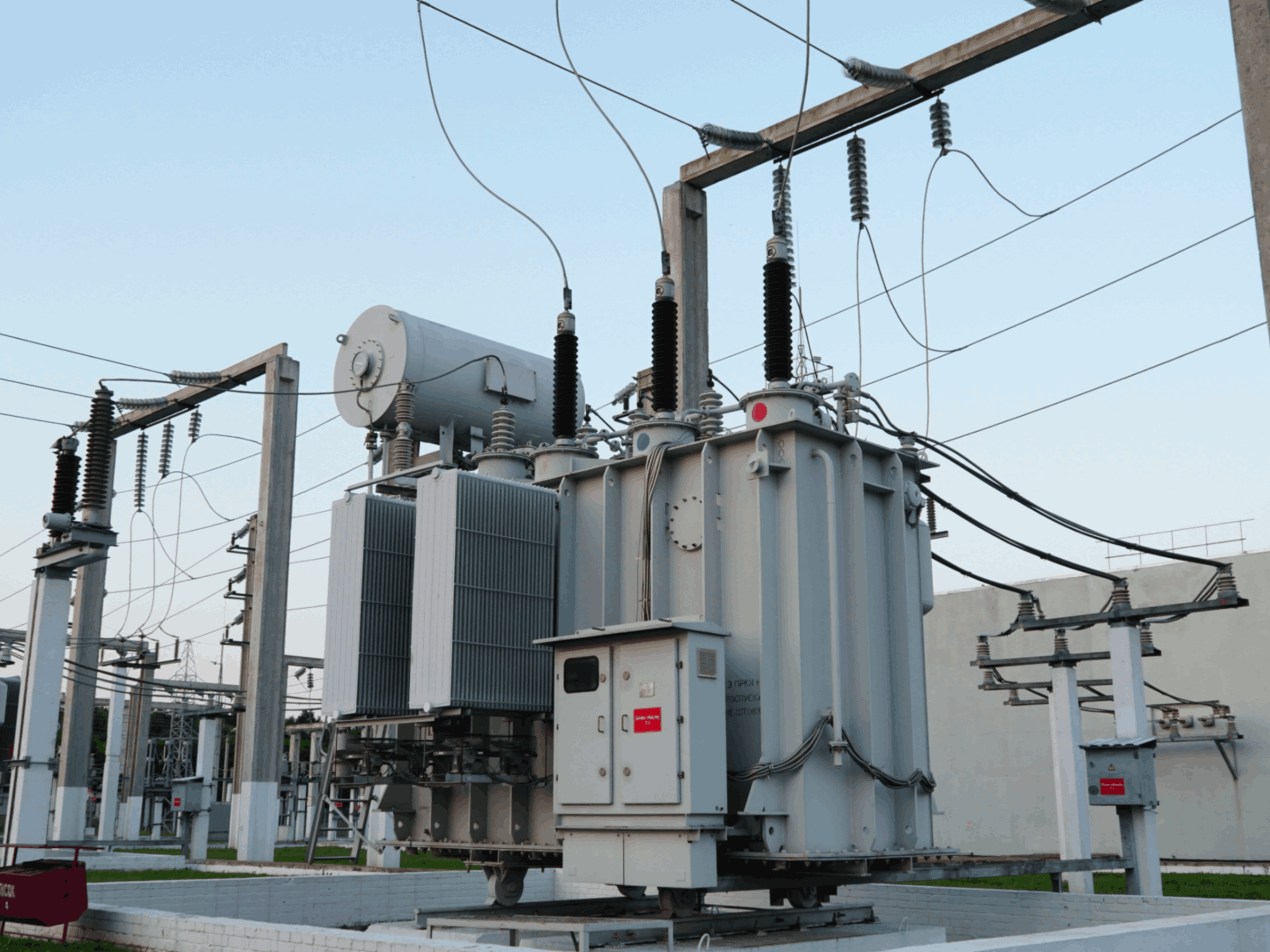
Insulation keeps high-voltage and low-voltage conductors from touching each other or the grounded tank. A transformer's insulation system has two parts: the liquid (transformer oil) and the solid materials (paper, pressboard, laminates).
Solid insulation degrades irreversibly from heat and moisture. Once the degree of polymerization (DP) of the paper drops below 200, the insulation is considered end-of-life. No treatment restores it. That's the core reason why dissolved gas analysis, moisture testing, and oil quality testing matter: they provide an early read on solid insulation condition before a failure forces the issue.
Transformer oil serves as both coolant and dielectric. Mineral oil is the most common type: low cost, good thermal and dielectric properties, and a long service history. Alternatives like FR3 (natural ester) and synthetic esters offer better biodegradability, higher fire points, and better moisture tolerance, at higher cost. The EPA also notes that vegetable-oil dielectric fluids are significantly less flammable than mineral oil, which is one reason ester-based fluids get attention in fire-sensitive applications.
Oil condition degrades over time from heat, oxidation, and contamination. Key indicators:
Oil testing every one to two years is standard practice on medium and large power transformers.
Bushings are the conductors that pass through the tank wall, connecting internal windings to external circuits. A standard bushing consists of a central conductor surrounded by porcelain or polymer insulation, sealed against the tank wall with gaskets.
High-voltage bushings on large power transformers use oil-impregnated paper (OIP) or resin-impregnated paper (RIP) designs, with capacitive grading layers that distribute electrical stress uniformly. Distribution transformer bushings are simpler, often solid epoxy or porcelain.
Bushing failures are among the most common causes of transformer outages. Contamination on the external surface causes flashover in wet or polluted conditions. Internal moisture ingress or insulation degradation causes capacitive grading failure. Damaged gaskets allow oil leaks at the bushing base. Bushings are external components and replaceable in the field, though HV bushing replacement on large units is a substantial undertaking.
Monitoring hardware doesn't make a transformer run. It tells you how it's running. For an operations team managing a critical feeder or a production facility where an unplanned outage costs thousands per hour, these components are what turn a potential failure into a managed event.
Most liquid-filled transformers carry three standard indicators:
Oil level gauge: Mounted on the conservator tank, shows whether oil volume is within normal range. A low reading may indicate a leak or significant thermal cycling. Float-type gauges are common; magnetic level indicators are more reliable on larger units.
Oil temperature indicator (OTI): Measures oil temperature near the top of the tank. Top oil temperature is a proxy for overall thermal loading. Most OTI units include alarm and trip contacts that trigger at set thresholds.
Winding temperature indicator (WTI): Simulates winding temperature using a current element and a thermal image circuit. WTI readings are typically 10–20°C higher than OTI because windings run hotter than the bulk oil. Alarm and trip contacts are standard.
Some units also carry a pressure/vacuum gauge on the conservator or a sudden pressure relay on the tank wall, depending on design.
Standard valves for maintenance and monitoring access include:
Ground lugs, lifting lugs, jacking pads, and nameplate brackets are standard external hardware. On larger units, oil flow indicators and Buchholz relay test valves are also present.
The most frequently replaced external accessories include:
H2LV maintains inventory of common transformer accessories for fast turnaround. For urgent requests, contact us directly.
Heat is a transformer's main enemy. Every watt of loss in the core and windings becomes heat that has to go somewhere. Cooling systems move that heat from the oil to the surrounding air, limiting operating temperature and extending insulation life.
Radiators are banks of pressed-steel tubes or channels bolted to the tank sides or top. Hot oil rises from the top of the tank, flows through the radiator tubes, loses heat to the air, and returns cooler to the tank bottom. No pump is needed for basic ONAN cooling. Thermal convection handles the oil circulation.
Larger transformers use wider or taller radiator banks, sometimes with multiple banks connected in parallel. Radiators are external and bolted on, which makes them replaceable in the field. A cracked weld or physical damage to a radiator is fixable without opening the main tank.
Cooling tubes are an older, similar technology: simple steel tubes welded directly to the tank wall rather than a separate bolted radiator bank.
IEC and IEEE both use a letter-code system for transformer cooling classes:
A transformer rated for ONAN/ONAF might operate at 100% load under ONAN and 125–133% under ONAF, depending on the specific nameplate rating. Both ratings appear on the nameplate.
Dry-type transformers use air instead of oil as the primary insulation and cooling medium. Cooling components differ accordingly:
Dry-type cooling requires no oil, so there are no radiators, conservators, or Buchholz relays. Maintenance focuses on air filters, fan motors, and temperature sensor calibration.
Protection components don't improve transformer performance. They prevent a fault from becoming a catastrophic failure. On a critical feeder, a functioning Buchholz relay or pressure relief device is the difference between a controlled shutdown and a fire.
The Buchholz relay is a gas-and-oil-actuated protective relay mounted in the pipe connecting the main tank to the conservator. When an internal fault develops, oil decomposes and releases gas. The gas rises through the connecting pipe and collects in the relay chamber, triggering an alarm. A more severe fault produces a rapid oil surge that actuates the trip contact, disconnecting the transformer from service.
Buchholz relay trips should always be investigated before re-energizing the transformer. Gas collected in the relay can be sampled and analyzed. Its composition indicates what type of fault occurred.
The sudden pressure relay (or rapid pressure rise relay) is an alternative or supplementary protection device mounted on the tank wall. Where the Buchholz relay responds to gas and oil surge, the sudden pressure relay responds to a rapid rise in internal pressure. Both devices are common on medium and large power transformers.
As a transformer heats and cools during load cycling, the oil volume changes. In conservator-style transformers, the conservator tank accommodates that volume change. Air enters and exits through the breather, a canister of silica gel that absorbs moisture from incoming air.
A saturated breather stops working. Most silica gel breathers use color-indicating gel: blue when dry, pink when saturated. Replacement is straightforward, and the gel is regenerable by heating. Breather replacement is one of the most frequently neglected maintenance tasks, and the most consistent way moisture enters a conservator-style transformer over time.
Sealed-tank transformer designs use a gas cushion (typically dry nitrogen) instead of a conservator and breather. No maintenance is required at this point.
Tap changers allow the turns ratio to be adjusted, compensating for supply voltage variation or load-side requirements. Two types exist:
DETC (De-Energized Tap Changer): Also called an off-circuit tap changer. The transformer must be de-energized before the tap position is changed. A manual selector switch rotates through two or three positions above and below nominal voltage, typically in 2.5% increments. Mechanically simple, no motor drive, minimal maintenance. Standard on distribution transformers.
OLTC (On-Load Tap Changer): Changes tap position while the transformer remains energized under load. A motor drive and contact assembly handle the switching operation. OLTCs appear on substation and power transformers where voltage regulation needs to happen continuously. They require more maintenance: contact wear, oil quality monitoring in the OLTC compartment, and drive mechanism service are all regular items.
OLTC failure is one of the most common causes of power transformer outages. Contact erosion, oil contamination, and drive mechanism wear account for the majority of problems.
Power transformers and distribution transformers share the same fundamental design, but they differ considerably in scale, complexity, and what's expected of them. The parts that matter most aren't identical, and neither are the replacement strategies, which is why a broader understanding of transformer types helps when you're comparing components and replacement needs.
Both types share the same core architecture:
For standard distribution units, these components account for virtually everything on the transformer. The rest is application-specific.
Power transformers carry additional components to manage the scale, regulation, and protection demands that distribution units don't typically face:
Distribution transformers are built for simplicity, low cost, and long unattended service life. Hardware reflects those priorities:
Pad-mounted and pole-mounted distribution transformers are designed for near-zero maintenance over a 25–40-year service life. Substation power transformers require much more active maintenance programs.
Most transformer failures are predictable. The components that fail most often are subject to mechanical wear, thermal cycling, or direct exposure to weather and contamination. Core and winding failures do happen, but they're rare compared to what fails at the boundaries: seals, bushings, and tap changers.
Gaskets are the most commonly replaced transformer parts in service. Every bolted joint on the tank uses a gasket: cover flanges, bushing mounting flanges, valve connections, and drain plugs. Nitrile rubber and neoprene are common materials; cork-rubber composites appear in older units.
Gaskets harden and shrink over time, especially under heat cycling. Oil leaks at gasket joints are the most frequently reported transformer maintenance issue. Left unaddressed, a slow oil leak eventually drops the level low enough to compromise cooling and insulation.
Replacing a tank cover gasket or drain valve gasket is straightforward. Bushing base gaskets are more involved, particularly on high-voltage bushings where the replacement process requires careful handling.
Bushing failures account for a significant share of transformer outages. Estimates vary, but bushing problems consistently rank in the top three failure modes across most fleet studies. Failures range from surface flashover (typically from contamination and wet conditions) to internal dielectric failure (insulation breakdown in OIP bushings) to mechanical damage from handling or through-fault currents.
Bushing condition assessment includes:
Replacement requires de-energizing the transformer. On large HV units, bushing replacement is a crane job. The hardware is heavy and connections require careful torquing and oil-tightening procedures.
Tap changers, OLTCs in particular, are the most maintenance-intensive transformer component. Every tap change operation wears the contacts slightly. A large power transformer with automatic voltage control may perform thousands of tap change operations per year. Contact erosion, arcing byproducts in the OLTC oil, and drive mechanism wear accumulate over time.
Signs of OLTC wear include:
DETC failures are less frequent but do occur, usually from corrosion at the contacts when a tap changer stays in the same position for years without cycling. For a facility manager who hasn't tested the DETC since commissioning, a stuck or high-resistance tap contact may be quietly degrading output voltage without triggering any alarm.
Before ordering any replacement part, three things need to be confirmed: what the unit is, what the component's specifications are, and whether replacement is the right call over repair or reconditioning. Skipping any step leads to wrong parts, wasted time, or a missed opportunity to catch a deeper problem.
The nameplate is the primary source of record for every transformer. If you need a deeper breakdown before ordering, this guide to decoding transformer nameplates is a useful companion. EPA’s guidance on transformer nameplate fluid identification is also useful on older units, because the nameplate typically identifies the dielectric fluid, fluid quantity, and related labeling details.
Key fields for parts identification:
On older or field-modified transformers, the nameplate may not reflect the current configuration. Cross-reference with as-built drawings or service records before ordering.
For external components, physical measurements prevent fitment problems:
When exact measurements aren't available, the unit serial number and manufacturer documentation are the fallback.
The decision between repair, reconditioning, and outright replacement comes down to three factors: the extent of the fault, the age of the insulation system, and how long the unit can stay out of service.
Repair makes sense for discrete external component failures — a failed temperature gauge, a leaking drain valve, a cracked bushing — where the rest of the transformer is in serviceable condition. The repair addresses the specific failed part without disturbing the rest of the unit.
Reconditioning applies when multiple components have degraded but the core and windings are still sound. Oil reclamation, gasket replacement, bushing replacement, tap changer service, and cooling system overhaul extend transformer life by 10–20 years.
Replacement becomes the practical answer when:
H2LV maintains replacement transformer inventory for situations where waiting on a repair isn't an option. If downtime is the deciding factor, transformer rentals may also help bridge the gap while you secure the right long-term solution. Contact us for availability and lead times.
The questions below cover the issues that come up most often when sourcing transformer parts or assessing component condition.
Often yes for low-voltage bushings. High-voltage bushings typically require partial oil drainage to drop the level below the bushing flange before removal.
The core rarely limits transformer life. Silicon steel cores last 50 years or more. Insulation degradation ends service life long before core wear becomes a factor.
Check the silica gel color. Blue means it's active; pink or white means it's saturated and no longer absorbing moisture. Replace or regenerate the gel.


