
High to Low Voltage helps utilities, EPCs, data center developers, and industrial buyers source three-phase substation transformer options for a wide range of projects.
Need a fast quote? Send MVA rating, primary voltage, secondary voltage, cooling class, LTC requirement, quantity, ship-to location, and required delivery date.
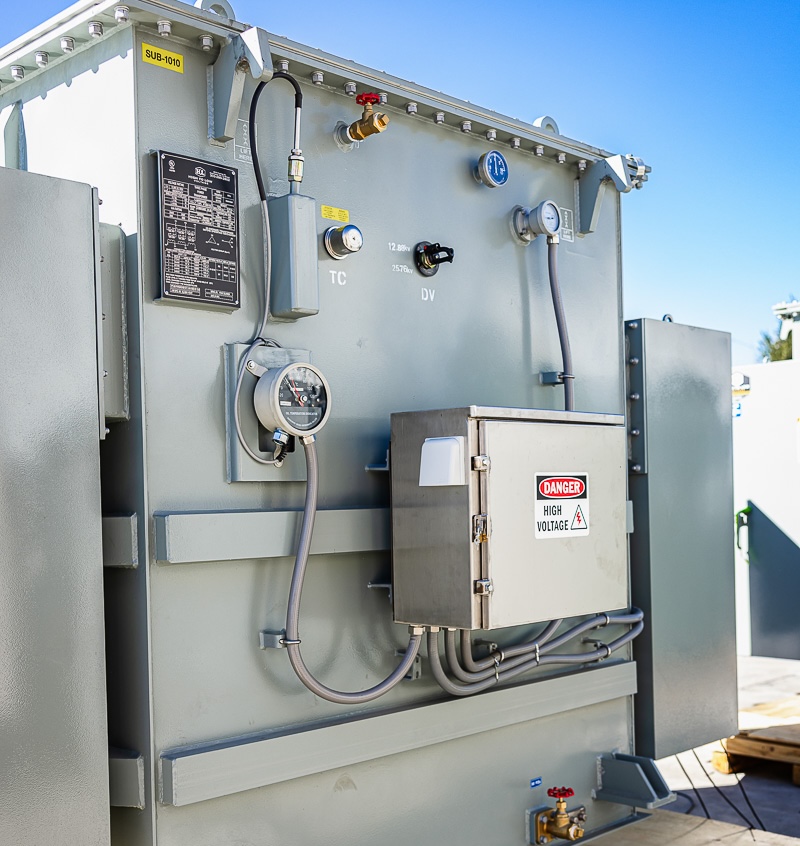
Substation transformers are not units you can grab off a shelf. Lead times can run 60 to 100+ weeks at the factory, and projects do not wait. Our inventory and sourcing model is built to move large units fast, whether you are starting a new build or replacing a unit that just failed.
We work with established suppliers, refurbishment partners, and project surplus channels to find units faster than the OEM queue allows. When inventory matches your spec, you save months. When it does not, our sourcing relationships often beat factory lead times by a wide margin.
Browse current availability in the H2LV store, or send your specs and we will tell you what we can source on your timeline.
We source smaller three-phase substation transformers in the 1500–5000 KVA range for industrial unit substations, customer-owned substations, and smaller distribution applications. These are the units that sit at the lower end of the substation class, often serving as primary step-down for industrial campuses, mid-size data centers, and large commercial sites.
For smaller distribution needs that do not require three-phase substation equipment, browse our single-phase transformers inventory.
For larger MVA ratings up to 70 MVA, see the specifications section below. Our transformer calculator gives you a quick first pass on sizing.
.png)
We carry select substation transformers in inventory and ready to ship. New stock units come from established suppliers and are matched to applicable ANSI/IEEE standards and project requirements, with documentation available on request.
Stock at this voltage and MVA class is limited because each unit is a major capital purchase. Inventory turns slowly because we do not speculate on configurations buyers may or may not need. When we hold a unit, it is because the configuration matches a real demand pattern across utilities, data centers, renewables, or industrial buyers.
If we have what you need on hand, you save months. If we do not, we can typically source faster than going direct to factory.
Our three-phase stock range covers the most commonly specified substation transformer configurations:
Need a substation transformer on a tight timeline? Send your MVA rating, primary and secondary voltage, cooling class, LTC requirement, and delivery date, and we will confirm what we can source.
Substation transformer quotes live or die on spec accuracy. The wrong cooling class adds months to lead time. The wrong impedance kills your protection coordination. The wrong BIL fails commissioning tests. Send what you have and our team will fill the gaps. The more of the following you can confirm up front, the faster we can match a unit
We source substation transformers across the full MVA range and voltage class spectrum used in distribution and sub-transmission substations.
MVA ratings scale with voltage class and load demand. Distribution substations typically run 5 to 30 MVA. Sub-transmission substations push into the 30 to 50 MVA range. Large utility, data center, and renewable substations frequently spec 50 to 70 MVA per unit, often with redundant configurations for N-1 reliability.
If your project specifies a non-standard voltage or BIL, send the utility specification and we will source accordingly.
Substation style is the more common configuration for outdoor utility and large industrial applications, where the transformer connects to a yard layout with separate switchgear, breakers, and protection.
Unit substation style is preferred for close-coupled industrial and data center applications where space is constrained, weather protection matters, or the entire assembly is engineered as a single piece of equipment.
We source both styles across the full MVA range. Tell us your installation type and we will quote accordingly.
Power class transformers are built to higher impedance, BIL, and short-circuit withstand requirements than distribution class. Power class also typically uses different design standards (ANSI/IEEE C57.12.10) compared to distribution class (ANSI/IEEE C57.12.00 and related). If your specifying engineer has called out power class, we will quote accordingly.
Substation transformers serving distribution loads typically include a load tap changer (LTC) for voltage regulation under load. Smaller industrial or fixed-load applications may use de-energized tap changers (DETC) only. Some larger industrial and data center applications use both: an LTC for ongoing voltage regulation and DETC for one-time setup adjustment.
Standard monitoring and alarm options include:
Optional advanced monitoring includes fiber-optic temperature monitoring and dissolved gas analysis (DGA) ports with online monitoring. If your specification requires a specific monitoring package or SCADA integration, send the spec list and we will match the configuration.
Many utilities and data center operators have standardized monitoring requirements, and we can configure units to match those standards before shipping.
HV and LV configuration options affect bushing type, lead arrangement, and how the transformer interfaces with the rest of the substation.
Bushing selection affects long-term reliability, especially in coastal, high-pollution, or seismic environments. Composite bushings have become more common in modern installations because they handle pollution and seismic loading better than porcelain. We can source either type to match your project specification.
Have a one-line diagram or utility specification? Send it over and we will help confirm the substation transformer configuration before quoting.
Substation transformers support large-scale voltage step-up and step-down needs across utility, industrial, data center, oil and gas, and renewable power systems. We source units for planned projects, capacity upgrades, and emergency replacement.
Investor-owned utilities and co-ops, including municipal utilities and rural electric co-ops, use substation transformers for distribution, sub-transmission, transmission, system upgrades, capacity additions, and outage response. We support planned procurement, emergency replacement, and spare unit programs.
Data centers and crypto mining sites use substation transformers for high-capacity primary power, campus distribution, and fast-tracked energization. We help buyers source units when factory lead times do not match project schedules.
Oil and gas operations use substation transformers for gas processing plants, compressor stations, large pump stations, and field substations. We support new builds, capacity expansions, harsh-environment requirements, and emergency replacement.
Solar farms, wind sites, and battery energy storage projects use substation transformers for collection, tie-in, generator step-up, and point-of-interconnection applications. We work with renewable developers and EPCs on planned procurement and accelerated deployment.
Substation transformer selection is more involved than padmount or pole mount. The wrong choice on impedance, cooling class, or BIL can create coordination, thermal, or insulation problems that show up months after commissioning. We help buyers spec the right unit. Send what you have and we will fill in the gaps.

Substation transformers are typically sized in MVA rather than KVA, and sizing involves more than just peak load. Send:
We will recommend a rating that fits your load profile without overbuilding. Substation transformers are expensive enough that overbuilding by 20% can mean hundreds of thousands of dollars wasted, and underbuilding can force a premature replacement. The transformer calculator is a quick first pass for base sizing.
Primary voltage is set by the utility or upstream system. Secondary voltage is set by your distribution or load requirements. Both must match your project's BIL specifications and protection coordination.
If your specifying engineer has provided a transformer specification or one-line diagram, send it as-is. We will confirm the configuration before quoting.
Substation transformers are major capital equipment with installation requirements that extend well beyond the unit itself. Common considerations:
If your installation has site-specific constraints (indoor vault, weight limits, restricted access), mention them on the quote request. Substation transformers are too large to fix problems in the field, and we would rather catch them before the unit ships.
Sourcing for a utility, data center, oilfield, or renewable project? Tell us your application, voltage class, MVA rating, and timeline, and we will help match the right unit.
H2LV supplies substation transformers across the United States. Whether you are placing a planned procurement order for a new utility substation, sourcing units for a hyperscale data center build, or chasing down an emergency replacement after a unit failure, we can move on the timeline your project actually needs.
Substation transformers are heavy haul shipments. Most units 5 MVA and above require permitted transport, and units above 30 MVA often need route surveys, escort vehicles, and coordinated delivery windows. We handle freight logistics from inventory pickup through final site delivery, including:
For emergency replacement, we coordinate with our freight partners to move units as fast as the permits and physical logistics allow. A 50 MVA unit cannot move overnight, but a vendor who knows the heavy haul process can save you weeks on a critical timeline.
Our substation transformer buyers include:
We tailor lead time, documentation, freight, and commissioning support to whichever bucket you fall into.
Substation transformers are not commodity equipment. A single unit can cost more than the rest of the substation combined, and a wrong spec or a missed lead time can derail a project worth tens or hundreds of millions of dollars. You should be able to talk to a vendor who treats it that way.
H2LV is built around a simple idea. When you need a substation transformer, you should be able to talk to a team that knows the equipment, has supplier relationships that move faster than the OEM queue, and gives you straight answers on price and lead time.
We carry inventory where we can. We source aggressively where we cannot. We do not push you toward a unit that misses your spec. We do not pad lead times to make our quote look better. And we back every transformer we ship with technical support from people who have spent careers around this equipment.
If your last vendor sent back a quote that read like a stall, send us your specs and see the difference.
Send your substation transformer requirements and we will respond with availability, pricing, documentation, and a real lead time.
If this is an emergency replacement, mention that in the request so we can prioritize sourcing and freight options.


